The short answer: lead time is not "how fast the factory is." It is how many waits you leave in the chain. In a typical 45-day order, only about 15 days are real production. The other 30 are waiting: for approvals, for materials, for a production slot, and for a vessel. Cut the waits and 20 days becomes a design decision, not a negotiation.
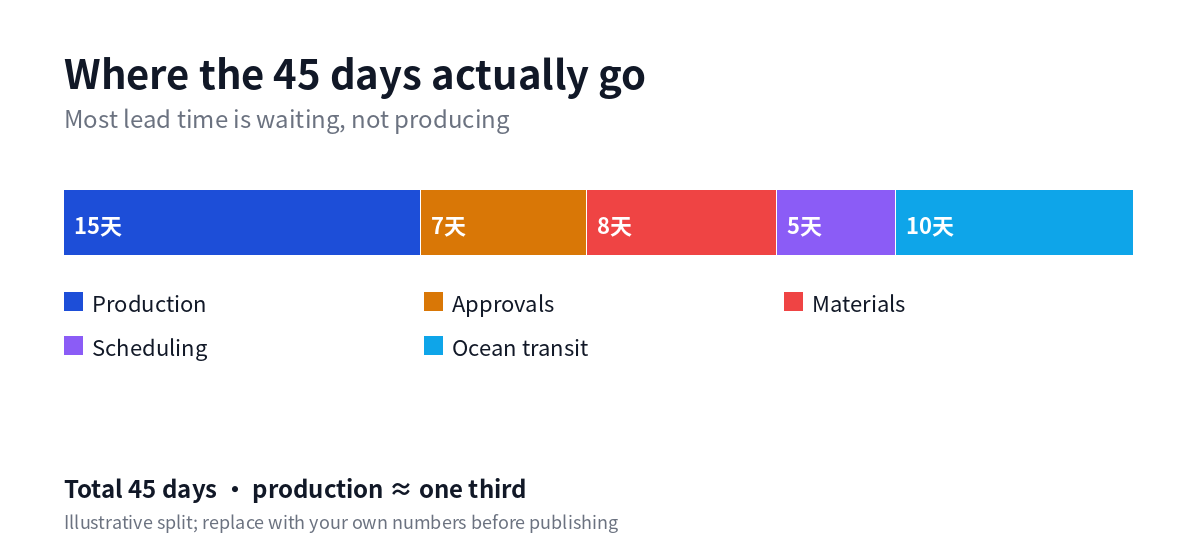
Here are the four changes I have seen work, in the order I would apply them. Each one states the change and the cost, so you can judge it yourself.
1) Split the order: "first small batch + replenishment"
Today: one order of 5,000 units, one production run, one shipment, 45 days.
Change: start with 1,000–1,500 units (20–30%) and replenish based on sell-through.
Why it works: the small batch has a shorter material, scheduling and production cycle—typically 15–20 days. Your buyer can list earlier and pay earlier, and you are not tying up the full amount of cash.
The cost: more changeovers, so unit cost rises a little (in my experience roughly 3–8%, depending on category). You trade that for less cash tied up and earlier payment. For most categories it is worth it.
2) Bundle the approvals into one round
Today: sample approval → process approval → packaging approval → shipping-mark approval. Each round takes 1–2 days. Four rounds is a week.
Change: one four-in-one approval sheet covering sample, process, packaging and shipping marks. Signed once, then no changes.
Why it works: the least controllable part of lead time is not production—it is how long the buyer takes to reply. Collapsing four rounds into one saves 4–7 days.
The cost: half a day of preparation on your side. It is the highest-return half-day in the whole chain.
3) Move quality control upstream
Today: inspect everything at the end. Find 5% defects → rework → seven more days.
Change: first-article approval plus a check every two hours. Problems surface within ten minutes.
Why it works: rework is the most expensive wait. Late rework costs time, a new production slot, and a new booking.
The cost: QC staff move to the line instead of waiting in the warehouse. For small batches this matters more, because there is no volume to absorb the rework.
4) Split the logistics: fast lane for the first batch
Today: the whole order waits for one vessel. Twenty days at sea.
Change: send the first 20–30% by air or fast vessel; the rest goes by the slower, cheaper route.
Why it works: ocean transit is the hardest fixed block in the chain. A fast lane brings it down to 5–7 days, and you only pay for it on a small quantity.
The cost: air freight does not work for low-margin, bulky categories. In that case use a fast vessel plus forward-stocking in an overseas warehouse.
A five-minute self-check
- ☐ Can this order be split into 20% first batch + 80% replenishment?
- ☐ Can the four approvals (sample / process / packaging / marks) be merged into one?
- ☐ Is there a first-article check, or only a final inspection?
- ☐ Is there budget for a fast lane on the first batch?
- ☐ Are the buyer's "expected date" and "must-arrive date" the same thing? (Many disputes come from mixing the two.)
One last sentence: lead time is designed, not chased. You can push workers. You cannot push "waiting for approval" or "waiting for a vessel."
FAQ
Is a 20-day lead time realistic for a factory that normally quotes 45? Yes, for a first batch of 20–30% of the order, provided materials are in stock or short-lead, and the four approvals are compressed into one round. The full quantity in 20 days is usually not realistic.
Does splitting the order always cost more? Unit cost rises because of changeovers, typically a few percent. It is usually offset by less working capital and earlier payment. Run the numbers for your own category before committing.
What should I fix first if I can only change one thing? The approvals. They are the cheapest to change and often the single largest block of waiting. Do that before touching production or logistics. Last updated: 2026-10-19 (FAQ and topic added)