A USD 20,000 order, 42% material, 22% processing. The quote left out inland trucking and port charges, and an 8% margin arrived at 4% after shipment. A unit price alone sends the buyer back with three more questions, which usually costs three days. Put the conditions on the page and the quote can become a signed PI.
The test of a quote
A quote passes when the buyer can sign and return it without asking for details.
Two conditions decide that. The price states the port and the Incoterm it applies to. The lead time states the day it starts counting. Miss either one and you renegotiate later.
12 fields
| Field | What to write | What goes wrong without it |
|---|---|---|
| Quote number and date | QT-2026-001, issue date | Buyer compares against an old version |
| Model and specification | Model, key parameters, material | Samples bounce back for a week |
| Quantity and MOQ | Tiered, 100 / 500 / 1000 | A small order ships at a large-order price |
| Unit price and currency | USD 12.80/pc | Mixed currencies break the settlement |
| Incoterm | FOB Shanghai | Freight ownership is argued after booking |
| Packing | Export carton, 20 pcs/ctn | Carton count changes, freight is recalculated |
| Lead time | 25 days after deposit | Buyer counts calendar days, finds a 5-day gap |
| Payment terms | 30% T/T deposit, 70% against B/L copy | Balance sits until arrival, cash tied up 30 days |
| Validity | 30 days, material increases excluded | An old price gets ordered three months later |
| FX basis | Calculated at 7.10, re-quote beyond ±2% | A 3% currency move erases the margin |
| Extra charges | Tooling USD 800, samples billed separately | The cost lands on you |
| Owner | Name, email, phone | The buyer routes through three people |
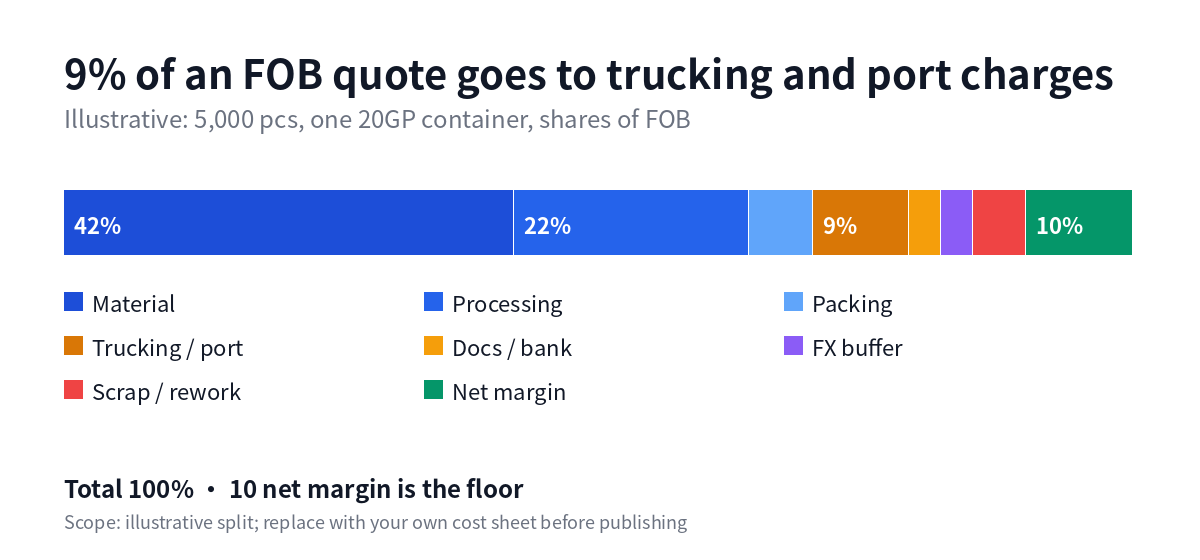
How an FOB price splits
| Cost line | Share of FOB | Note |
|---|---|---|
| Material | 42% | Current purchase price; add a price-adjustment clause |
| Processing | 22% | Labour and equipment depreciation |
| Packing | 6% | Export cartons and pallets |
| Inland trucking and port charges | 9% | The line most often forgotten |
| Documents and bank fees | 3% | Customs, certificate of origin, collection fees |
| FX buffer | 3% | Quote to settlement usually runs 60 to 90 days |
| Scrap and rework | 5% | Estimate from past batches |
| Net margin | 10% | Below 5%, one rework eats the order |
Illustrative split for 5,000 pieces in a 20GP container. Replace it with your own cost sheet; categories and routes move these numbers a lot.
Drop inland trucking and port charges and you have given away 9% of the quote. That is how an 8% margin becomes 4%.
Three terms, three sets of duties
| Term | Export clearance | Main freight | Insurance | Risk passes |
|---|---|---|---|---|
| EXW | Buyer | Buyer | Buyer | At the factory |
| FOB | Seller | Buyer | Buyer | When goods are on board |
| CIF | Seller | Seller | Seller | When goods are on board |
CIF adds ocean freight and insurance on top of FOB. Minimum cover is enough for the quote; if the buyer wants all risks, add the premium to the sheet instead of agreeing to it verbally.
Four leaks
Port charges and document fees. For a 20GP, port charges plus customs normally run a few hundred to just over a thousand CNY (illustrative). Small against the order, large against the margin.
Validity written as "open". Material prices move twice a year. An open quote can still be ordered at last year's price. Write 30 days, or state that the price is confirmed at order.
No FX re-quote line. Quote at 7.10, settle at 6.90, and a USD 20,000 order loses about 4,000 CNY. A ±2% clause gives both sides a clean exit.
Tiered prices without thresholds. The gap between 100 and 1,000 pieces can be 15%. Without the threshold, buyers order 100 and ask for the 1,000 price. State whether tooling and samples are credited, too.
When this sheet is not enough
For standard products shipped FCL or LCL, 12 fields are enough. Custom parts and project orders usually need a proposal with drawings, acceptance criteria and a schedule, because the buyer will ask for a cost breakdown.
Sample orders can shrink to six fields: model, quantity, unit price, freight, lead time, payment. Small amounts close faster with short terms.
FAQ
Does a quote need a validity date
Yes. 30 days is common. For volatile materials, use 7 days and state the adjustment condition. A quote without validity is a permanent option handed to the buyer.
How much higher is CIF than FOB
The difference is ocean freight plus insurance. Illustrative: a 20GP from Shanghai to a European base port runs USD 1,200 to 2,500, and insurance costs 0.3% to 0.5% of cargo value. Peak season can double the freight.
How do I answer a 5% price cut request
Ask about quantity and payment first. Doubling volume, a higher deposit or a looser lead time each buys room. If none is available, quote a reduced configuration and state which part or certification is removed.
How soon should I follow up after sending a quote
Two to three business days. The first note asks one question: does anything in the specification need adjusting. If there is no reply, send updated lead time and sailing schedule on day 7, without repeating the price.
Last updated: 2026-10-23