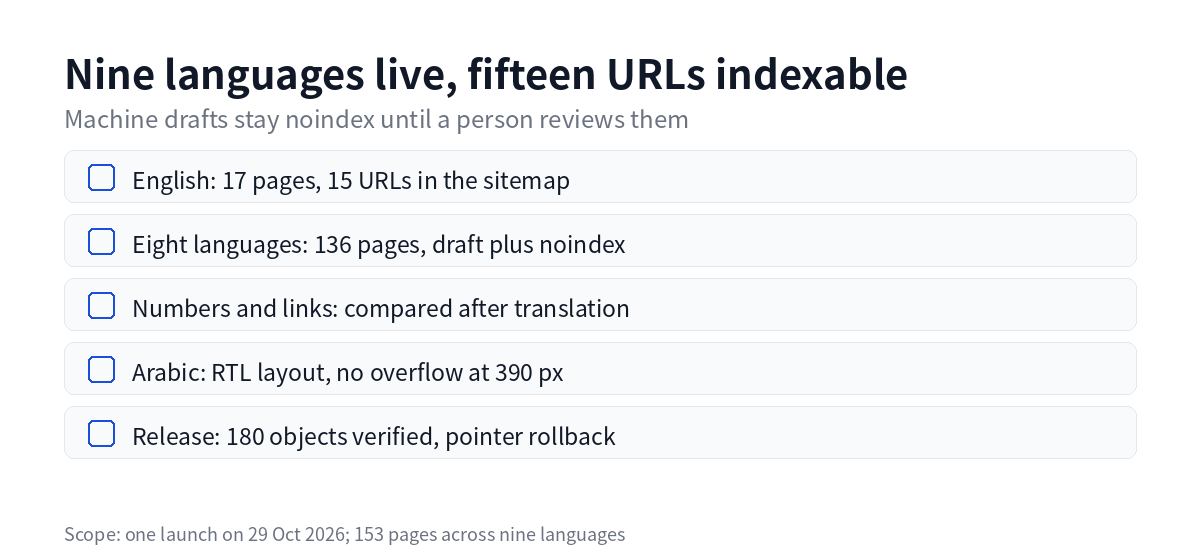
On the morning of 29 October, nine language versions of a thermostat exporter's site went live. All 153 pages load.
The sitemap lists 15 URLs. Every one of them is English. The other 136 pages carry noindex.
That split was deliberate. Machine translation can ship in a day. Indexing rights are granted one page at a time.
What went live
English stays at the root. Each of the other eight languages gets a prefix, and every language has the same 17 pages.
| Language | Path | Pages | Status |
|---|---|---|---|
| English | / |
17 | 15 URLs in sitemap |
| Chinese | /zh/ |
17 | draft, noindex |
| Spanish | /es/ |
17 | draft, noindex |
| French | /fr/ |
17 | draft, noindex |
| German | /de/ |
17 | draft, noindex |
| Arabic | /ar/ |
17 | draft, noindex, RTL |
| Portuguese | /pt/ |
17 | draft, noindex |
| Japanese | /ja/ |
17 | draft, noindex |
| Korean | /ko/ |
17 | draft, noindex |
The language menu lists nine entries. Pick one and the site links keep the matching prefix. Switching language keeps you on the same page instead of sending you home.
The release holds 180 objects: 153 HTML files plus images and styles. That number comes back during verification.
When a site should add languages
More pages do not automatically mean more reach. Each language adds 17 pages to review, and review is the bottleneck.
| Signal | What to do now |
|---|---|
| Inquiries arrive from three or more language regions | Open those languages, one per quarter |
| The English site has produced inquiries for three months | Start with two languages |
| The English site has no inquiries yet | Fix English pages first |
| No glossary exists for the target language | Build the glossary, then translate |
| One person runs operations | Two languages at most |
The last row is the practical one. Translation can be outsourced. Product terms and numbers can only be checked by someone who knows the product.
Protect numbers before style
Machine translation damages numbers and links more often than tone.
The script masks brand and model names, numbers and units, certification abbreviations, and Markdown link targets before sending text out. It restores them after translation, then compares structure. The set of numbers must match the source. So must the set of links.
One missing number, or a hyphen inside a model name turned into a character, sends the page back for retranslation. These are hard errors, not style issues.
The eight non-English versions skip the English copy gate. That gate checks length, tone, and first-screen phrasing; applied to translations it produces false positives at scale. English pages still run the original gate and must score zero errors before release.
Arabic needs its own test
Arabic pages set dir="rtl". Body text reads correctly. The form broke.
The contact form has a honeypot field for bots, invisible to people. Under RTL it moved off screen and produced a horizontal scrollbar at 390 px. Switching to direction-neutral positioning removed the overflow.
Acceptance tested two widths, 1440 and 390. Form fields were complete at both, and the submit path was unchanged.
Release by pointer
The release goes to a versioned directory first. Nothing on the live site changes. After all 180 objects upload, each is downloaded and compared. Two files timed out on the first pass; after a retry all 180 matched.
A pointer file selects the live version. Rollback means pointing it back at the previous directory. Old versions stay in place. Yesterday's rebuild used the same method with 44 objects; today it was 180.
Trade-offs and what is missing
Keeping translated pages out of the index gives up 136 entry points for now. In return, weak pages do not enter search results or compete for English URLs.
Translation quality is below review standard. Product terms suffer most in Chinese, Arabic, and Japanese; some terms have no settled equivalent in the target language.
The admin panel shows real status only. An engine that has not launched reads "planned", with no button. Production releases still go through a separate script to prevent misclicks.
Two items remain: human review, and one-click publish and rollback in the admin. Neither belonged on launch day.
FAQ
How long does a multilingual site take?
This one took under a day for machine drafts across 153 pages. Review runs per page; a skilled reviewer needs 20 to 40 minutes for a product page, so 153 pages is dozens of working hours.
Can machine-translated pages be indexed right away?
Not advisable. A page with wrong terms, units, or specs can enter the index and stay cached after a fix. Keep noindex on, open pages one at a time, and accept slower growth in exchange for fewer wrong pages reaching buyers.
Which languages come first?
Look at the language of current inquiries and customer emails. Without data, ship English plus one language, run it for three months, then choose a third. Nine languages at once only suits a site whose structure is already stable.
Do translated pages hurt English rankings?
Noindexed pages stay out of the sitemap and do not set each other's canonical. As long as each language has its own URLs, translated pages do not take weight from English pages.
Why keep English at the root?
Existing links and accumulated weight point at the root. Moving to /en/ requires 301s for unclear gain. New sites can start with /en/; established ones should stay put.
Last updated: 2026-10-30