One customer took eleven months to place a first order.
He replied three times in that stretch, always with the same line: the project was under evaluation. The salesperson did not chase him daily. He sent something on a fixed schedule. In month five, a photo of a new mold. In month nine, a note that lead times on a similar product had moved.
In month twelve, the customer placed a first order worth 40,000 dollars.
Follow-up runs on rhythm. Wording comes second. Customers forget what you said, but they remember that you were still there.
What customer follow-up means
Customer follow-up is planned, repeated contact between the first conversation and the first order. The goal is narrow: when the buyer needs to purchase, you are the first name that comes up.
Two numbers tell you whether it works: reply rate and quote conversion. A low reply rate points to the content of your touches. Low conversion points to the quote or the product.
Sort accounts into three tiers first
One schedule for every account is the same as no schedule. Tier them.
| Tier | Profile | Cadence | Effort per touch |
|---|---|---|---|
| A | Confirmed need, stated timeline | Every 3 to 7 days | Custom proposal, calls allowed |
| B | Need exists, timing open | Every 2 to 4 weeks | Industry news and new products |
| C | Quoted once, no reply | Once a quarter | Bulk-level information, low cost |
Re-tier every quarter. Upgrades should be noticed, not waited for. When a B account starts asking about lead time and payment terms, that is the signal to move it to A.
Test: if eight of ten accounts in your sheet are tier A, the tiers are not real.
Four anchors, one job each
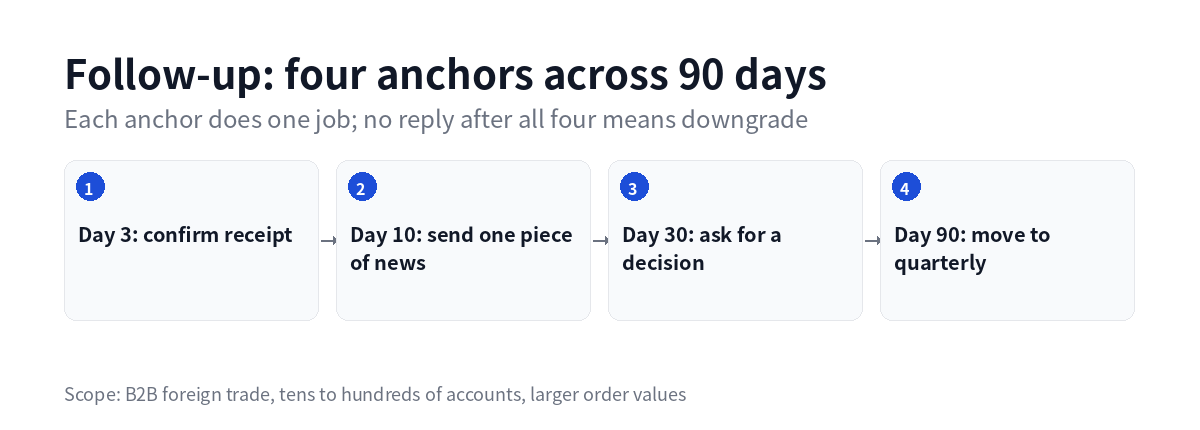
Day 3. First touch after the initial contact. One purpose: confirm the message arrived. Keep it short and attach one specific question.
Day 10. Second touch. Give information, not pressure. An application case from the same product category works. So does one change in the industry.
Day 30. Third touch. Offer a clear choice: continue, pause, or switch to another option. Making the buyer decide beats waiting.
Day 90. Move to quarterly maintenance. One message a quarter, valuable content only, no order chasing.
If all four anchors pass without a reply, downgrade the account. Downgrading exists to move your hours to accounts that are closer to buying.
Four stages, different moves
After the quote. Silence usually means the buyer is comparing prices. Send one short message that asks for the reason and offers two options: price or lead time. Let them pick one, then talk.
After the sample. Confirm delivery on day three, ask for test results on day seven. Many salespeople skip this. The sample arrives, nobody asks, the buyer forgets.
When negotiation stalls. It usually stalls on payment terms or MOQ. Offer a middle path, such as a lower MOQ on the first order with a higher unit price. That moves faster than another round of explanation.
After the order. Follow-up is not finished. Report two production milestones without being asked, then confirm receipt one week after shipment. Repeat orders are decided in this stretch.
Accounts that have not ordered in five years
These accounts usually have a need. Another supplier is filling it. Pushing harder does nothing. Wait for a trigger.
Four triggers are worth waiting for: the buyer changes procurement staff, expands capacity, has a problem with the current supplier, or upgrades the product category. All four show up in LinkedIn activity, industry news and exhibitor lists.
Contact after a signal. The hit rate is far above cold sending. With no signal, one industry update per quarter is enough.
Test: an account with no interaction for two straight years moves from the follow-up sheet to a watch list. The watch list takes no daily time.
Fields the follow-up sheet needs
The tool does not matter. The fields do. At minimum:
- Company and contact name
- Tier, A/B/C
- Source channel
- Date of first contact
- Last interaction date and what was said
- Next follow-up date
- Current blocker: price, lead time, certification, or the decision chain
Field seven gets skipped most often and helps most. It tells you what to talk about before you dial.
Three common mistakes
Mistake one: treating follow-up as chasing. Asking "have you considered it" every time makes buyers hide. Follow-up earns its place by bringing new information.
Mistake two: only following accounts that do not reply. Accounts already in negotiation get neglected. How fast you answer a tier A account decides whether the deal closes.
Mistake three: thin records. When a salesperson leaves, the account history is blank and the next person starts from zero.
Where this fits
This cadence suits B2B foreign trade with tens to hundreds of accounts and larger order values.
It does not fit two cases. Cross-border retail sells to end consumers, where repeat purchase depends on product and logistics, not manual follow-up. Platform inquiries reward speed over cadence; the first two hours decide the outcome.
Follow-up is also one part of closing. For how to build the quote itself, see export quotation. For the first reply to an inquiry, see the inquiry reply template.
FAQ
The buyer said "not needed". Should I keep following up?
Yes, at a lower tier. Move the account to quarterly maintenance, send industry information only, stop asking for orders. Some come back within six months. Deleting the record throws away the work already spent.
How many accounts should one person handle in a day?
It depends on tier. Three to five tier A accounts a day, each with something specific. Tier B can be batched. Tier C runs once a quarter in one block.
Email gets no reply. Switch to phone or WeChat?
Change the channel first, keep the content. No reply by email, try LinkedIn, then a call. If a new channel also gets silence, the content has no value to that buyer. Change the content.
Will a high cadence get me blocked?
It can. Weekly is acceptable for tier A and harassment for tier C. Cadence has to match the tier. That is the point of tiering.
Do existing customers need follow-up?
Yes, with a different focus. Existing accounts need repeat-order timing and new categories, not a first sale. Two proactive updates a year on production and lead time beat ten greetings.
Last updated: 2026-10-27